heart Home About Me Contact Reviews Friday Contests heart
Showing posts with label fatphobia. Show all posts

Monday, November 14, 2016

YA Review: Outward Blonde by Trish Cook

Outward Blonde by Trish Cook

Published: October 18th, 2016 by Adaptive Books
Genre: Contemporary YA
Binding: ARC
Page Count: 280 in my ARC, but the back of the ARC says 320 so I'd go with that.
Part of a series? Nope.
Got via: The publisher sent me a copy for review consideration.
Amazon / Book Depository / Indiebound

Summary (from goodreads): Sixteen-year-old Lizzie Finkelstein is a hard-partying socialite who lives a charmed life with her mother in Manhattan. After a public drunken sexual escapade results in both an arrest and an embarrassing viral video online, Lizzie’s parents stage a late night intervention. Lizzie finds herself whisked away to Utah to learn a lesson or two about taking responsibility at Camp Smiley, a wilderness survival program for troubled kids.

Camp Smiley is a far cry from Lizzie’s high society life in New York. Without her stable of luxury hair/makeup items, her teacup Pomeranian, contact with the outside world or access to social media, Lizzie must face the harsh conditions of the outdoors. Grouped with troubled campers in which she’s certain she has nothing in common (except Jack, who’s pretty hot), Lizzie must now learn to dig her own toilet in the woods and build a fire by rubbing two sticks together before the camp will ever let her go back to her former existence. She has a choice: get with the program, or get out of there.

Review: Let's get this out of the way - I didn't like this. The writing is fine. The writing is probably the best part of the book, as it's engaging and entertaining. If you can ignore the representation of the real life thing, and you enjoy kind of that chick flick feel type of book, you would probably like this fine. I could not do that. There will probably be spoilers in this review, and I apologize for that, but I feel they are necessary.

To explain something - Adaptive Books basically publishes books based on movies, to put it in a way that amuses me. More specifically and more accurately, they re-purpose abandoned movie scripts and screenplays into books. I think that's a really unique idea. Outward Blonde was based on a script that was going to be a Hilary Duff movie, and as someone who has seen a lot of Hilary Duff movies, I can totally see that. (Which might also be a way to figure out if you'd like this - I imagine if you're a fan of, say, Material Girls, you'd probably be into this.)

Part of me actually wonders if the movie didn't get made because of another movie released a few years ago. This is all me speculating, but Hilary Duff hasn't really played a teenager in a few years, which would be right about the time Brat Camp, a Mila Kunis movie, came out.

This I bring up to say - I think the camp aspects of this book are incredibly mishandled, and because of the origins of this story, I am not sure that's entirely the author's fault. If this is the story she was given to work with and she could only change so much, I think she did the best job possible. However, what it comes down to, is I think this book is based on something in real life that is at best ineffective and at worst deadly. And that is something I cannot get behind.

Plot Talk: Simple plot - rich girl gets really drunk, gets arrested, gets sent away to wilderness camp, deals. I think this is a messed up plot because of reasons I will get to in my "Cons" section, but the actual execution of it is fine. It doesn't drag or anything.

Characters: Lizzie is an incredibly privileged girl, and I had issues with her now and then. A lot of it improves, especially her self-esteem, but even at the end of the book moments when I had issues with her. The idea that women in Africa who make and sell their own fashion want or need a rich sixteen year old white girl to sell their things in the US is, uh... probably something that should have been edited out. She's pretty typical fare for this type of book, honestly. Okay, but not my favourite.

I did think it was neat that Lizzie has a chronic illness. She has IBS, and that's a really neat idea... that is not treated very well by the book. A therapist in the book says her IBS and acne are being triggered by stress (and not washing her face for three days in the woods clears up her acne... as everyone with acne knows, not washing your face does that). Meanwhile, she's been eating tons of beans and dried fruit at camp, which are foods that can cause IBS symptoms to flare up. You, uh. Don't think that might be connected to it?

I was pretty meh about the other characters. They fell flat for me. I'll say it was nice not everyone was white and straight, but I'm still pretty meh about them. One of the characters, Lizzie's love interest specifically, cyber-bullied another kid, who attempted suicide. We are supposed to be sympathetic to this character. I was not.

PG-13 stuff: There's underage drinking, sexual content, a lot of cursing, toilet humour, and a lot of it feels gratuitous, frankly. A lot of it feels like cheap movie comedy, if you know what I mean.

Cons, complaints, bad stuff, etc.: Hooboy. So let's do this thing. My biggest problem with this book is it feels like someone say Holes and thought, "Hey, Camp Green Lake was actually a good idea!"

I think most of these wilderness programs are either useless because they're run by untrained, unqualified people, or straight-up dangerous for the same reason. The book mentions Outward Bound, and obviously the title is based on that. I did some research, and Outward Bound seems like a completely different beast than these types of programs the book is using. For one, people who do it actually consent to the experience. (Article about a death in an Outward Bound program found here, for fairness' sake.) I'm not going to go into my own feelings about that particular program, but people do consent.

Let me make this clear - Lizzie's parents hire people to come take her away in the middle of the night, and she is not allowed to leave the camp. This makes Camp Smiley the other kind of wilderness program, which I will be calling a brat camp through this review for clarity's sake.

Brat camps are dangerous. (Link one here.) They take advantage of scared parents, but they also take advantage of abusers. There are some that include conversion "therapy" used against queer teens. Kids are injured, are physically, emotionally, and sexually abused, die, and are left with emotional trauma they have to deal with for years. There is no evidence these brat camps work, although things haven't been researched well, but what evidence there is suggests they make things worse.

At one point in the book, Lizzie and her friends escape from camp and run away. They hitchhike, and they ride in the bed of a pick-up truck because there aren't enough seatbelts. I do not believe you could research enough to write this book, and not know about Bruce Staeger. After spending two years in a brat camp, he was killed there while riding in the bed of a pickup truck when it rolled, as the camp officials had ignored orders regarding seat belts.

Many of these articles I'm linking talk about food deprivation and even starvation. Once during the book, Lizzie is denied s'mores with the others. The articles about these camps talk about teenagers being called liars or fakers over things that injure or ultimately could kill them like dehydration, heat stroke, or seizures. Lizzie is called a liar when she runs away into the woods, a raccoon steals her baby blanket, and she tries to tell someone. Maybe these parallels are coincidences - I sure hope they are! - but they illustrate how lightly this subject is taken compared to the seriousness of its nature.

I think I've made my point that I think this is not well handled, so I'll just share my links so you can read up on this yourself. Here's one, here's two. For fairness sake, I'm going to include the experience of a parent who found one of these brat camps a positive for her child (although please do note the fact she's completely okay admitting she drugged her teenage daughter with sleeping pills... just saying), and another who had mixed feelings. Here is one and two articles from people who were sent to these programs. And, finally, here is a 1995 article from a magazine, because I want to point out this is not a new phenomenon, and neither are the deaths related to it. Please be warned there is very disturbing content at most if not all of these links, including fairly graphic descriptions of the deaths of teenagers. I think these are important articles to read, but be kind to yourself, please. The first link in this paragraph has the least graphic content, and is similar in tone to what I have written here.

Other things - this book uses a ton of references. At one point, Lizzie matches with James Franco on Tinder and tries to hook up with him. Besides the fact the book literally has him say he didn't know the girl he actually hit on was under eighteen, which is, um, not true (and frankly, a really gross stance to take considering Lizzie isn't even 17 yet), it's a very, very dating reference. There are tons of these. Some of them I honestly don't even think are believable, like Lizzie suggesting she would volunteer as tribute for any of the other kids at camp were this the Hunger Games. It's borderline trying too hard at times, including the overuse of AAVE in a book with no black characters.

Well, besides the ones in Africa who never appear who made the "weird pajama pants" Lizzie's dad gives her, who Lizzie, the seventeen year old white girl, think need her to market the fashion they make and already sell on their own. I know I already mentioned that, but it really bugged me.

There is also a scene where Lizzie tries to use her baby blanket to pick up a raccoon and carry it around. It was obviously meant to be funny. Mostly I cringed. That seemed so cheesy comedy movie, you know? I didn't believe anyone could actually think they could find a wild raccoon in the woods and make it their friend. That's just... no.

The book also tends to be somewhat fatphobic and weirdly slut-shamy and also virgin-shamey at the same time. It's weird. I wasn't a fan. And one more pet peeve - the book also tries to tell us, as I stated before, that stress is triggering Lizzie's acne. Apparently her first three days in the woods where she does not wash her face are not stressful. Because everyone with acne knows not washing your face helps your zits a lot, right??

Cover comments: It's very cute, and catches the mood of what they were trying to do. I also did enjoy all the "extra" things the book included like medical reports and lists and things like that. I like it when a book adds in that kind of thing.

Conclusion: I've been thinking about this book for like two days as I write this review (yeah, it took a long time) and I realized I wanted this to be more like Little Blog on the Prairie. I wanted cute and funny, and the book tries, but the subject matter is so serious I can't buy into the cute and funny. And you know, honestly, the Outward Bound approach might have even been better in this book, if it had involved Lizzie's entire family doing wilderness stuff to bond and work through their issues, and not her actually being kidnapped into something against her will.

I enjoyed Notes from the Blender, and by no means do I think Trish Cook is a bad writer. But I think this subject matter, with the deaths and abuse in it in real life, can't work as a comedic source. I think when you end the book with Lizzie improving from the program, you are essentially endorsing these programs. With everything out there I've read now, I just cannot believe that is safe to do. I wrote most of this review before the US election result was announced. The soon to be vice president of the US believes in conversion therapy. With the current state of things in the US, I think these programs will only become more dangerous than they already are, and because of that, I can't give this more than one rose.


Other notes:

- I'm going to start keeping track of when books have characters share mascara. YOU'RE GOING TO GET AN EYE INFECTION.

Peace and cookies,
Laina

Monday, October 24, 2016

YA Review: Don't Ever Change

Don't Ever Change by M. Beth Bloom

Published: July 7th, 2015 by HarperTeen
Genre: Contemporary YA
Binding: ARC
Page Count: 359 in the ARC, but goodreads says 368 in the finished copy. I assume they are correct.
Part of a series? Nope.
Got via: I was sent it for review consideration, and yes I've had this one for a year now. At least it's not 2011.
Amazon / Book Depository / Indiebound

Summary (from goodreads): Eva has always wanted to write a modern classic—one that actually appeals to her generation. The only problem is that she’s starting to realize she can’t “write what she knows” because she hasn’t really lived. So the summer before heading off to college, Eva is determined to live a life worth writing about.

But soon Eva’s story starts to go in unexpected directions, like growing apart from her best friends, working at a job she is completely unqualified for, and even falling for the last person she would have ever imagined. Like anyone, though, it will be up to Eva to figure out how she wants this particular chapter in her story to end.

Review: This is an odd one. I think I liked it, but I'm not entirely sure yet on all my thoughts yet. It's probably going to take me the rest of this review to figure them out. I can definitely say this is not a book for everyone. It's kinda weird, honestly. Mostly I enjoyed that weird, but it probably wouldn't be for everyone. It's going to depend on whether this is your flavour of weird. Eva is a writer, as it says in the summary, and a great deal of the book is her arc in learning to experience things and not just observe them, so a lot of the book has a very removed feeling. There's some fourth wall teasing in the talk about characters and readers.

I'm personally a fan of the summer after high school graduation YA, and I've also enjoyed gap year YA. I would actually like to see more of them, and ones that are absolutely, definitively aimed at teenagers. I mean, it's a confusing time for a lot of teens. So much of high school is built up as "the best time of your life", so what happens after? How do you decide what happens next? What if your plans change? How do you deal? I think when YA can get that balance and talk about that weird transition time, it can be really interesting, and really important, and I think teens will really connect to it.

Does Don't Ever Change do that? Mostly. I didn't personally always love it, but I think for the most part it's interesting, and I do think there are teens out there who really would love this.

Plot Talk: Simple plot. The summer before college, Eva is given some writing advice from her teacher and decides to try and follow it. She works at a summer camp with nine-year-old girls, dates a few people, and learns about herself. The plot works fine, and it doesn't drag or anything. No complaints about it.

Characters: Eva was originally described to me as unlikeable (something I really enjoy), and the funny thing to me is, the people around her come off as more unlikeable than her to me! It's kind of interesting, actually. She does have some snarky moments, but honestly a lot of the time I think they were justified. It's kind of interesting - Eva doesn't really come off as rude, or mean, or anything like that, but she's reserved, quiet, sometimes a little snarky, and keeps to herself a lot. You can see how other characters could think she's stuck up or uninterested in them. It's really an interesting thing, and very relateable.

Like I said, I did think some of the other characters can come off as a little jerky. They are teenagers, though, so I can't really say it's completely a bad thing. Like there are characters who judge Eva as uptight or stuck up for not liking parties, and one even says something about how she didn't even try and have fun. Like, not everyone likes parties or finds them fun? But then at one point, that characters apologies and says that they know parties aren't everyone's thing. It's a good balance, and I enjoyed it.

I also really loved the relationship Eva has with her sister. It's very sweet. And the campers she works with are really cool. I'm pretty fond of camps in books for someone who never went and hates the outdoors, but I tend to like the kid stuff way more than the kissing stuff, and I liked that there was a lot more focus on her campers than on her romantic life.

Now, something I'm actually a little conflicted about. I don't exactly think this is a fat-friendly book, but it did some things I want to talk about. One of Eva's campers is chubby, but besides one comment about her not being truly fat "yet", the book always calls her fat. Eva is not always nice in her comments about this kid. The line "happy as a fat little clam" comes up, and that's kind of - wow. I don't think the word fat is an insult, mind you, but Eva isn't commenting about anyone else's body but the fat kid's.

But... another character kind of calls her out on it. It's a little subtle, but there's a character who doesn't seem to approve, and Eva seems embarrassed in the moment. Later, at the end of the book, it's revealed that the girl's parents basically expect the camp to make their daughter lose weight because "health" and Eva defends her.

I'm going to talk about that a little more later, but I thought I'd mention that here.

PG-13 stuff: There's a fair amount of smooching in this book. Some mentions of drinking, but it's pretty mild. A little strong language I think, some talk of sex. The back of my ARC says 14 and up and that's probably about right.

Cons, complaints, bad stuff, etc.: Like everyone is straight and the book is very white. There's some ableist language that is seriously unnecessary, and a weird line about some of the other counselors (who are like 17 or 18) from Eva's camp finding one of the CITs hot (who is 13). That was uncomfortable.

And there was a fat joke from Eva that I was really not fond of at all. Eva making a joke about her friends calling her fat when she's obviously thin, and since there's only one fat character in the book, and that character is not treated exactly positively, it rubbed me the wrong way. Now to wrap up what I was talking about in the character section - I don't think this is necessary a fat positive book. If you're a former fat kid, you might not want to read this one. I wish the author had been more hard-core in pointing out that everyone, including Eva, was treating Alexis horribly because she was fat.

I mean, it also would be nice if a book pointed out that dieting doesn't work, we don't know how to make fat kids thin (but we do help give them eating disorders), we don't even know how to make fat adults thin, or that what the camp and Alexis' parents were doing would be completely against anything that's actually healthy for her and goes against current AAP guidelines... but yanno. That'd probably be asking too much.

I'm not taking points off for this, because I think in the end it's okay enough, since the narrative does seem to say that Alexis' parents were completely in the wrong, but I do wish Bloom had done a little more.

Cover comments: This is a nifty cover, but I can imagine the hardcover getting a ton of fingerprints. It also looks awful on a white background, lol. In person, it stands out well. It also fits the tone of the book being kind of quirky and different.

Conclusion: Well, we've reached the end, and I think for the most part, I've decided I liked it. There are some things I didn't love, and somethings I would have wanted more from (seriously though not one queer person?), but I enjoyed reading it. I don't think it's going to be for everyone, but it's an interesting, weird book. I definitely think there are teens out there who are going to connect to it. I look forward to the author's future books, too. I think she has great potentional, and I want to see what she does next. I'm going to give this one three and a half roses.


That's all, folks!

Peace and cookies,
Laina

Monday, October 17, 2016

YA Review: Hourglass Series

Since I have all three books in this series, and we kind of need to get through some of the backlog of my review stack, it's probably easiest just to put them all in one post. This is just going to be one post, but I might have a couple more series posts in the future. Well, at least one, probably. We'll see what happens.

Reviews for the second and third book will probably have spoilers for the ones coming before them respectively, and the series summary will probably have spoilers for the last book or the entire series as I talk about my feelings for the entire thing.

This might be long.

This will probably be long.

Hourglass by Myra McEntire

Published: June 14th, 2011 by Egmont USA
Genre: YA Paranormal Romance
Binding: ARC
Page Count: 397 in the ARC, 390 in the finished version according to goodreads.
Part of a series? Yup, this is the first book in the Hourglass series.
Got via: Egmont sent it to me for review when they, you know, still existed. I'm sorry. We're getting closer to the present though!
Amazon / Indiebound

Summary (from goodreads): For seventeen-year-old Emerson Cole, life is about seeing what isn't there: swooning Southern Belles; soldiers long forgotten; a haunting jazz trio that vanishes in an instant. Plagued by phantoms since her parents' death, she just wants the apparitions to stop so she can be normal. She's tried everything, but the visions keep coming back.

So when her well-meaning brother brings in a consultant from a secretive organization called the Hourglass, Emerson's willing to try one last cure. But meeting Michael Weaver may not only change her future, it may also change her past.

Who is this dark, mysterious, sympathetic guy, barely older than Emerson herself, who seems to believe every crazy word she says? Why does an electric charge seem to run through the room whenever he's around? And why is he so insistent that he needs her help to prevent a death that never should've happened?

Review: This is another one I probably would have loved if I had actually read it in 2011. I still liked it, but there are certain things that bother me more now. We'll wait to get to those. Good stuff first. I adore the idea of this. I love the creepy ghost-type things, and as I was reading this, I realized how long it'd been since I read an amazing YA paranormal. I don't think Hourglass quite got me to amazing, but I liked it enough to keep reading, and to be excited about future books.

These characters have a lot of potential. I loved the dynamic between Emerson and her brother. A much older sibling relationship can be really interesting and different, and I really enjoyed seeing a relationship between an older teenager and her adult brother who had become her guardian when their parents died. He's supportive, but at times unsure of how to handle the promotion to parenthood, and I'm excited to see more of that dynamic. I do think Emerson could be somewhat flat, and I wanted to know more about her interests and her wants, but she's fine for a main character. Her voice can be really cute sometimes, and does have some little quirky bits that are nice.

And I did appreciate that there were a number of characters of colour - but at times that had some issues. Emerson's best friend Lily gets a lot of comparisons of her skin to food. And compared to a dog at one point. It's meant to be a good thing, that she's very loyal, but it's... uncomfortable. Every POC character is from somewhere outside of the US. They are all immigrants. All of them. That has some unfortunate implications.

There's also no fat people, or disabled people besides Emerson (and I will get to the issues of that element), or queer people. Why is everyone so straight? Every single person? Really?

For the most part, I like the romance in the book. It just isn't anything incredibly unique, honestly. It's kind of the same tropes you see a lot with the same problems you see a lot. Mostly with boundaries/controlling behaviour, although to be fair, both of them cross some. (Breaking into someone's apartment to snoop in their bedroom is weird and not okay even when you're a girl, Emerson. Not cute. I don't care if you had keys. That's weird.)

There is a bit of a love triangle, so if you're sick of them, this one might not be for you, but this is the kind I actually like better. Just because you met someone like a week ago and were attracted to them, doesn't necessarily mean that you're not going to be attracted to other people you meet. I like that more than books that tell me that the romance is huge and epic and soulmates and together forever - except wow, here's this new person! Kind of a rant there to say I didn't mind the love "triangle".

So what's left. PG-13 stuff - there's some language, some kind of scary bits, nothing I would say needs an especially mature reader to handle. Basic YA content. The cover is great. It's really cool, and I like how it kind of fools you so you're not exactly sure what's going on until you look twice. It reminds me weirdly of Alice Through the Looking Glass. (Book, not movie.) I like it! Thumbs-up.

Oh, boy, now it's time for my big complaint, isn't it? Okay, settle in, folks. This one is going to take a minute. There may be spoilers. I'm going to give some credit here to Alyssa at the Eater of Books, whose review of another book made me think of a lot of things I'm going to talk about here.

Part of the premise of this is that Emerson has been commited because of a combination of depression and seeing ghost-things. This happens often in books and movies, although a lot of the time the reveal is that the protagonist isn't "crazy", but is actually seeing ghosts/monsters/whatever. I won't say I haven't enjoyed books with that theme, because I have. But the problem is... this is a problem. This is ableist, and borderline dangerous. We owe teenagers better than to tell them that antidepressants and other psychiactric medications change you, that they make you dull, or a zombie (and yes, Hourglass uses the word zombie), or unable to feel things. You know what makes you not able to feel things? DEPRESSION.

Emerson says she has anxiety. Emerson says she has depression. But so much of the book takes the time to tell us she's "not crazy". It tells us that she went off her medications without telling anyone and that's treated as completely fine. Did you know going cold turkey from some antidepressants can make you incredibly sick or even kill you? The book intertwines Emerson's mental illness with her seeing ghost-things a lot, but she had a mental illness triggered after her parents died. It was exasperated by the ghost-things, yes, but not caused by them. There's a really big problem with this narrative. It creates stigma. It's irresponsible.

I don't like these narratives. I don't like the line about "crazy people" not getting to "claim self-control as a personality trait". I don't like the talk about "chemicals". I don't like that there seems to be a line drawn between Emerson who's "not crazy", and people who are. She was mentally ill. THAT'S OKAY. You can just... have a mentally ill character without needing to excuse it, or separate your character from the scary "crazies". I would not ever call this disability or mental illness representation. I winced every time something happened in this vein.

Now to wrap this up. Would I recommend this? I... don't know. I honestly think it's going to depend on how the other books are. If they continue to get better as I hope they will, I think I could recommend this very carefully for some people, with notes on the problematic aspect of the mental illness element. I love the atmosphere, and the characters are good. There are plot elements that I won't spoil that I think are really unique, and really fun to read. I still want to read the other books in the trilogy, and find out what happens next. And you guys know I kind of love the "secret school for kids with magic powers" idea.

So I'm going to give this one three out of five roses. The ableist elements bother me a lot, but there's enough good stuff to pull through.


Other notes:

- Why is Emerson's sense of smell so strong? I don't think you can smell cereal from across the room. That's odd.

- Emerson. It's not okay to tell other people that someone's pregnant before they've announced it. She literally tells people that someone is pregnant ten minutes after they peed on the stick. If the worst happens and that person has a miscarriage, do you think they want to tell that to all the people you told, Emerson? Boundaries!

Timepiece by Myra McEntire

Published: June 12th, 2012 by EgmontUSA
Genre: YA Paranormal Romance
Binding: Hardcover
Page Count: 325 plus the acknowledgements.
Part of a series? It is obviously the second book in the Hourglass triology.
Got via: The library.
Amazon / Indiebound

Summary (from goodreads): Kaleb Ballard was never supposed to be able to see ripples - cracks in time. Are his powers expanding, or is something very wrong? Before he can find out, Jonathan Landers, the man who tried to murder his father, reappears. Why is he back, and what, or whom, does he want?

In the wake of Landers' return, the Hourglass organization is given an ultimatum. Either they find Landers and the research he has stolen on the people who might carry the time gene, or time will be altered - with devastating results for the people Kaleb loves most.

Now Kaleb, Emerson, Michael, and the other Hourglass recruits have no choice but to use their unusual powers to find Landers. But where do they even start? And when? And even if they succeed, it may not be enough...

Review: Well, look at what surprised me! First of all, I was not expecting the POV change, since I didn't read the summaries to avoid spoilers. That works so well. First of all, Kaleb was one of my favourite characters in Hourglass. And I enjoyed Emerson's POV, but I thought the series was going to go that kind of cliche YA trilogy where the epic love of the first book is suddenly not so epic for the second book until you have to wrap things up in the third book. I'm not saying that can't work, but you know. We've all read it more than once, and I'm not terribly fond of it.

Timepiece says, "Nah, we're gonna go somewhere else," and I say, "Okay!"

A lot of things are just better in this, and I'm glad about that. Lily's character is much more fleshed out in this, along with her grandmother and her family history, and it's lovely to see that given time and care. It gets a little bit "pair the spares" (and it's a touch predictable that these two characters would have a romance), and the romance is pretty fast, but they're super cute and have a ton of chemistry so, whatever. I'm good with it because it's done well.

I also really, really enjoyed Kaleb as a narrating character. He has a lot of depth and a very sweet center hidden under a buttload of guilt and not so amazing decisions. He's always interesting, but it's wonderful when he grows and shows off his depth. He can definitely be a little obnoxious at the beginning of the book, but when you get past that, he gets a lot better. My favourite part that describes him perfectly is that he's big as a house, wearing leather, covered in tattoos and piercings... and he bakes cookies when he's depressed.

The plot works really well both as a sequel and to carry over into a third book and wrap up the series. I'm really excited to read the third (seriously, it's staring at me right now and I want it). I don't think the book is amazing at using all the character it has in groups at once, like with, say, the Naturals series that y'all know I love.,. It has more of a tendancy to divide the characters into two or three. But honestly I don't have any major complaints about this one. There's still a bit of ableism with Emerson's premise like I talked about, but because we're not in her POV, it doesn't really come up so much, and that helps a lot with me enjoying the book.

So, final verdict: Three and a half roses, and a short review because I desperately want to read the third book already.


Other notes:

- Seriously, this one does not have the scent fixation. Emerson, what's your deal with your sense of smell? That might be your other super power - the ability to smell a bowl of cereal from across the room.

Infinityglass by Myra McEntire

Published: August 6th, 2013 by EgmontUSA
Genre: YA Paranormal Romance
Binding: Hardcover
Page Count: 293 plus the acknowledgements.
Part of a series? The third book in the Hourglass triology.
Got via: The library.
Amazon / Indiebound

Summary (from goodreads): From the moment the Hourglass group violated the rules of the space time continuum to rescue a murdered loved one, time has been in flux. People from other centuries slide into our time, intruding into our space, threatening our world.

Frantically seeking a way to turn back this tide, the Hourglass begins a search for the legendary Infinityglass, tracking it to the city of New Orleans, a place where the past rests easily with the present.

Quiet, reliable Dune, the group's favourite geek, is selected to travel to the Crescent City and somehow retrieve the renowned object.

But there's a problem.

Because the Infinityglass is not an object, it's a person.

A beautiful, headstrong dancer named Hallie, a girl so enticing Dune can't take his eyes off her.

And time is not on her side.

Review: This one is also pretty good! I did have a few issues, but it was mostly enjoyable. This one has duo POVs between Dune and Hallie, and Hallie's voice is so different from the previous books. I really enjoyed her voice most of the time, and the duo POVs are unique to this book in the series, and work pretty well. Dune and Hallie are super flirty, and the build-up and tension between them is probably my favourite part. The tension is great.

Overall, I do think that this is a good way to finish out the series. Everything is wrapped up nicely, and I didn't feel like anything was unfinished or left hanging. The setting of New Orleans was cool, if a touch underused. This is a very fast-paced book, and I enjoyed it for the most part.

But I did have a few issues. I'm not altogether fond of the way these books handle sexuality, specifically the sexuality of the teen girls. It doesn't get into major sex-shaming, but there are parts that get annoying. At one point Hallie's dad basically says "no guys and girls sleeping in the same room" which... he doesn't actually really know them? Like he assumes two guys and two girls means two hetereosexual couples. Who are teenagers. Maybe your guests were going to be fifty year old lesbians, didja think of that? He's essentially policing not only the sexuality of his own teenaged daughter, but of girls he's never met. And it's kind of icky, not gonna lie.

Other parts have some unfortunate implications.

First of all, Kaleb has taken out his nose and eyebrow piercings and only left his ear piercings because apparently happy, well-adjusted people don't have non-ear piercings. That's pretty much the only reason. Apparently they don't shave their heads either. The idea that people only do body modifications or alternative looks because they're having emotional pain is really, really annoying. I'm probably gonna have purple hair here pretty quick. It's not because I'm messed up emotionally, it's because it looks cool. Happy people can have eyebrow piercings.

Second, there is some fatphobia. At one point, Hallie stops needing to eat. She's a ballet dancer. The idea of a ballet dancer not having to eat is... not such a great idea. She also says something about dancing three times a week keeping her thin - that's annoying mostly because there are fat ballet dancers. Gonna go ahead and assume that people in a ballet troupe dance more than you, Hallie. Weight is not that simple. And Dune starts working out for "fear of turning fat". If it was just these two characters, it would be annoying, but I'd be like, "whateve". But there is NOT A SINGLE FAT CHARACTER in any of these books. Not one. So you're losing points for fatphobia. If you have NO fat characters, you don't get to have characters who are afraid of being fat without me critcizing it. What kind of message are you trying to send with that?

At one point, Dune says to another character that "you either have a maid, or you're OCD." OCD is not an adjective. This is more ableism, which this series definitely has a problem with.

Probably the last thing I'm going to talk about is some of the unfortunate implications with Dune. I enjoy his character, but there are things that I looked at twice and I'm not sure are so kosher (especially since I'm a white girl over here). His nickname is Dune because he raced over the sand dunes as a kid to get to the beach. Are you... are you entirely sure there's not more than one kid in American Samoa that does that? Most kids like the beach. I'm kind of assuming that extends to most Samoan kids. At the beginning of the book, Dune also cuts off his dreadlocks to look more professional (his words, not mine) and at one point, Hallie says she likes him better without them because she can run her hands through his hair. I'm not going to make a judgement call here, since these things are really complicated, but I'm gonna warn you about that so you can make the decision one way or the other of how you feel about that.

As a book, I enjoyed it, but I worry a lot that that's privilege talking. I do think this book had issues, but it was enjoyable. I think some of the problems might be things others don't want to read, though, so I'm warning you guys. My final thoughts on this book are - I liked it. Would I recommend it - carefully. With the things I've mentioned in mind, maybe. Overall, I'm probably only gonna give it three roses. I'm glad I finished the series, and I'm not angry at the book, as much as it might sound, but I don't think everyone would necessarily love it.


Other things:

- If you put bread in the toaster and start it toasting, and then you start cooking bacon, your toast is gonna be cold and rock solid by the time your bacon is done. So either you have psychic bacon powers, Hallie, or someone knew you weren't going to have any bacon that wasn't you, and had you start the toast for convenience.

Okay, my series summary:

If you like somewhat tropey YA paranormal romance, you're probably going to enjoy this. If you're sick of certain tropes, you might hate this, honestly. Time travel is not something I personally see a lot in YA, and I really enjoyed that premise. The author is pretty good at writing exciting romantic relationships, and the cast is not entirely white. How well that's done is not up for me to decide, so I'm not gonna try.

Many of the decisions this series took surprised me in good ways. Character choices, plot decisions, and even POV choices surprised me, which considerably toned down almost all of the predictability.

Something that was entirely predictable was the "pair the spare" tendancies. By the end of the third book, basically everyone was dating someone, and I don't think writing established couples is the author's strongest suit. Everyone gets very cutesy and overly perfect. And maybe that's my bias, but I found it a little annoying. Have a fight or something, people. And, of course, everyone is straight. Over a thousand pages total, multiple cities, and not one character is queer? At all? Not one?

Now, the ableism problem. The big problem is that the series at once tells me to take mental illness seriously by saying how bad it would be if Emerson was in a mental hospital, but also makes jokes about it by saying people with very clean apartments "are OCD". The book wants me to believe that I wouldn't want to read a book about a girl who was severely mentally ill and physically scarred, and tries to use that possibility as shock value. I don't think throwing a line into the third book about Emerson still has bad days dealing with depression fixes the mixed messages throughout the series, especially not the borderline-dangerous ones about medication.

I honestly think the author is very talented, and I would be interested in future books. I enjoyed this series, but I don't think the author was ready to tackle certain things in this book that she tried, and the inexperience does show at times in mixed messages and hopefully unintentional problematic themes. I think this series can be fun, but I know those issues could hurt people, so I can't recommend it wholeheartedly. I have a lot of mixed feelings, but I think I've laid them out as clearly as I can.

I hope you guys enjoyed this at least a little, and hopefully it was helpful and informative!

Peace and cookies,
Laina

Monday, June 22, 2015

Things I've Read Recently (18)

If you're new around here, Things I've Read Recently is a series of posts I do that are basically mini-reviews of books that I either forgot to review, didn't have enough to say for a full review, or just didn't want to do a full post about for whatever reason.

This edition are four random books I grabbed off my shelf because I need shelf space and it's kind of a casual goal of mine to read more books I own. You probably have no interest in any of these books, but it was fun to read things that were incredibly ridiculous while I was really stressed out, so here they are so I can drag you into my misery.


The Wrong Way Out by Linda Barr

Published: 1990 by Willowisp Press
Genre: Contemporary YA, or upper MG
Binding: Paperback
Page Count: 142
Part of a series? Nope.
Got via: I think I bought it at a yard sale or something.
The only place I can actually find selling this is ebay. If you want it, I'll sell it to you WAY cheaper than that! I stole the picture from there, though, because the one goodreads isn't big enough. Oh, Abebooks has two copies for like 10 dollars a pop. Seriously, if you desperately want this, tell me, and it's yours.

Summary (from goodreads): No matter how hard I try, I can't understand why my best friend is hurting herself. Ever since her parents split up and her father moved away, she's been acting weird. And the worst part is that she's been drinking. Kirsten

Why does everyone try to tell me what to do? First my mom, then my brother, and now Kirsten. I especially don't understand what's bugging Kirsten. She's becoming really bossy lately. And she's always lecturing me about drinking. What's the big deal? Jackie

Kirsten and Jackie have been best friends since third grade. They shared just about everything - until drinking came between them. Could Kirsten convince Jackie that she had a choice - and that drinking was definitely... The Wrong Way Out

Thoughts: This was so ridiculously cheesy. First of all, can we talk about how these girls are supposed to be 14? They look like they're 30 on the cover!

The writing is kind of awful. Nobody talks like that, and part of the narration is literally one of the girls reading from her Health textbook. It reads like the book equivalent of an afterschool special, and not a good one. It's just completely unrealistic, preachy, and again, so, so cheesy.

Yeah, so, this one won't be staying on my shelf. I'll probably donate it somewhere, if I can find somewhere that'll take it. Or hide it on the library sale shelf when no one's looking.

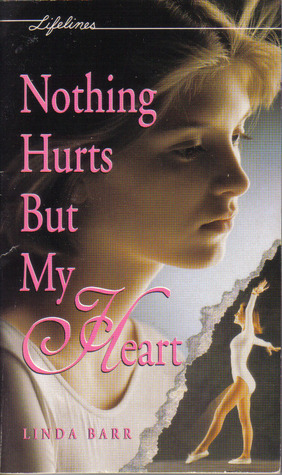
Nothing Hurts But My Heart by Linda Barr

Published: This edition was published December 31st, 1995 by Pages Publishing Group, with a previous edition in 1987.
Genre: Contemporary YA, or upper MG
Binding: Paperback
Page Count: 109
Part of a series? Nope.
Got via: A yard sale or something.
Amazon and then besides that, Abebooks is about the only thing worth linking.

Summary (from goodreads): Lisa Conklin is sure that this is a nightmare. An important gymnastics meet is only a few weeks away, and now there is something wrong with her back. The doctors are saying it's scoliosis and that Lisa might have to give up competing. But nothing hurts, Lisa tells herself.

Thoughts: Oddly enough, this one was actually better than the last one. The writing was still not amazing. It was third person, but it switched to first person "thoughts" too much, which was jarring. The language is pretty dated and I imagine the subject matter is, too. They've probably made a lot of advances in treatments in the 20-28 years since this was published.

Despite its flaws, I kind of still enjoyed this one. It was very quick, at least. Since it's so thin, I may just keep it. I have a soft spot for it because I've had it for so long, honestly.

Skip the next two if weight loss talk gives you the brain spikies.

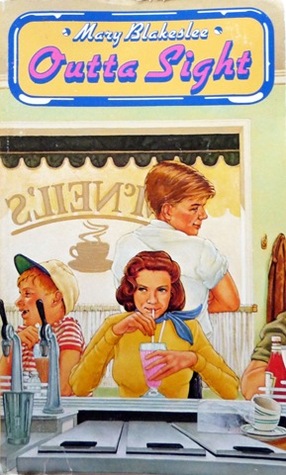
Outta Sight by Mary Blakeslee

Published: January 1st, 1987 by Scholastic
Genre: Contemporary YA
Binding: Paperback
Page Count: 212
Part of a series? I don't think so
Got via: Probably another yard sale. I've had it for ages, and really don't remember.
Amazon / Abebooks 

Summary (from goodreads): Hope's two most favourite pastimes in the whole world are eating and daydreaming. In her dreams she is rich, beautiful, famous and, best of all, popular - nothing like the overweight, dumpy teenager that stares back at her every day from the mirror.

Then comes the summer of 1944 and suddenly Hope finds her wishes coming true - some of them, anyway. With the help of her cousin, Hope learns how to become the beauty she's always wanted to be. And sure enough, the boys do come flocking. But where are all her friends disappearing to?

Thoughts: I really did not like this. The writing is okay, although it's fairly dated and at times uses language that would make most people fairly uncomfortable (slurs, etc.). But the subject matter is a whole different story.

First of all, this is set around the war, but Hope is barely aware of it. At most, it's an inconvenience to her, like that she can't get underwear with elastic. She's incredibly shallow, honestly, and it's not pleasant to read about.

More annoyingly to me is how focused on weight loss the book is. Hope is characterized as fat and eating constantly, emotionally eating, sneaking chocolate, binging when emotional, gorging at meal times, and basically as being addicted to sugar. Cutting out sugar and washing her hair more/using "liquid green soap" and calamine lotion on her acne makes her hair not greasy and her skin magically clear (because no teenaged girl ever has, you know, hormones causing that stuff) and she loses almost 65 pounds in less than two months. Because that sounds healthy.

Hope's starting weight? 175 pounds. She starts out with a 30 inch waist which is treated as this massive size. Guys, she's a size 12. Her cousin apparently has a 20 inch waist. You know what you find when you google a 20 inch waist? Corset training. But Hope is a size TWELVE. Here's an Old Navy size chart, here's an American Eagle size chart (and neither have clothes for a 20 inch waist, not even "0" sizes). She is literally average. She would wear a large T-shirt. Not extra-large or 2x or 3x, but a large. A size TWELVE.

Just keep repeating that to yourself for a while. Apparently she diets herself down to 110 pounds in a couple months, which is in no way concerning or dangerous, obviously. But apparently she's so much healthier, and the boys all fall over her and everyone loves her, yada yada, it's The Fantasy of Being Thin in book form. And, of course, we only see the happy honeymoon period, and not the part where the weight comes back.

I do not recommend this, and it will not be returning to my shelf.


Warning: Baby-Sitting May Be Hazardous to Your Health by Cynthia Blair

Published: January 23rd, 1993 by Fawett
Genre: YA/Upper MG Mystery
Binding: Paperback
Page Count: 118
Part of a series? Yes, this is like 3 out of 5 of this "A Bubble Gum Gang Mystery" series.
Got via: It's a weeded library book, so a library sale.
Amazon / Abebooks

Summary (from goodreads): As far as Samantha is concerned, there are all kinds of mysteres. Can she handle baby-sitting as an after-school job? And why does the most popular girl in school actually want to be her friend? But the scariest mystery of all is also the most dangerous: someone is selling secrets at her dad's computer firm - and his business is in trouble. It's definitely a case for Samantha and her two other Bubble Gum Gang pals, but the price of finding the spy may be way too high...

Thoughts: Apologies for the awful picture. The biggest thing that annoyed me in this one is that one of the characters, Carla, is apparently fat and is dieting throughout the book to lose five pounds so her parents will throw her a frozen yogurt party. She's twelve. No one needs to be dieting at twelve. She's probably about to go through puberty! And seriously, look at the girl on the cover (the one with dark hair). She's tiny. Old YA books were awful to fat, or even chubby characters.

That was annoying, but luckily it didn't dominate the story, so I didn't have a stroke from the stress. Otherwise, I liked it alright. It's pretty dated (twelve year olds carrying purses!) and the plot is not nearly as dramatic as the summary, but I like mysteries, I like the "Girl gangs doing stuff" genre, and the baby-sitting angle is always pleasing to me, so in general, this one will probably keep its shelf space. I just wish it hadn't had the dieting subplot!

Well, that was... fun? For lack of a better word. On the plus side, I have a little bit more shelf space now! And I feel less ranty. I'm sitting here staring at several library books now, so hopefully next week we'll have some books that are actually, you know, good.

Thanks for reading anyways!

Peace and cookies,
Laina